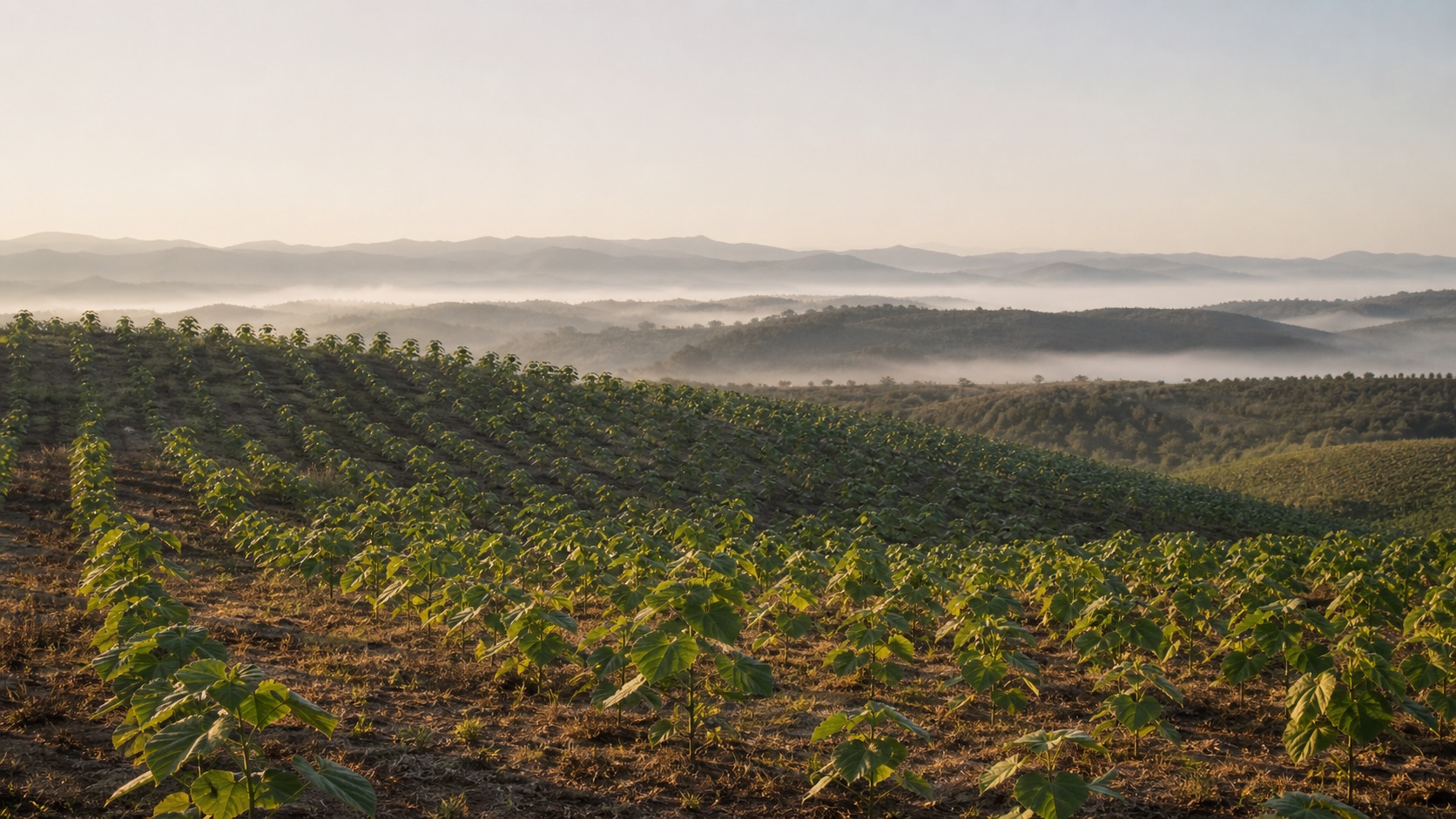
KIRI VERDE cultivates Paulownia fast-growing timber on 240 hectares in Portugal — with three structural revenue streams, officially recognised pilot status, and a team from the heart of the European Paulownia industry.
No theoretical bet. Both decisions rest on operational factors that reinforce one another.
Paulownia reaches premium timber quality in 6–8 years — conventional forestry requires 40–80 years. After each harvest the root system re-sprouts without replanting (coppicing), permanently reducing operating costs.
Reference: UTAD Penafiel trial (Portugal), WeGrow Spain operation Talavera
Central Portugal and the Alentejo fringe combine adequate winter rainfall with dry summers — Paulownia's optimal growing window. Frost events below −10 °C are rare enough to keep apical-shoot risk manageable.
Advantage over DACH region: no annual growth loss from late-winter frost
The European Commission approved a €250 million state-aid package for the Portuguese forestry sector in March 2026 — running until end of 2029. Afforestation projects on agricultural land are explicitly eligible. As an officially recognised pilot operation, KIRI VERDE receives priority in application assessment.
Source: portugal.gov.pt, European Commission March 2026
Portugal has no ownership restrictions for foreign EU entities. Land acquisition via NIF and notarial deed is standardised. Lease agreements of up to 25 years for forest plantations are legally established.
Reference: ELRA Portugal, Agribusiness Guide VDA 2025
Verra's Afforestation/Reforestation methodology VM0047 v1.1 was recognised as Core Carbon Principles-compliant by the ICVCM in September 2025 — the highest integrity mark in the voluntary market. Removal credits receive a premium over legacy REDD+ certificates.
Source: Verra Registry, ICVCM 2025
Between tree rows the Mediterranean climate provides ideal conditions for lavender — low maintenance, a robust cultivar, first harvest from 2028. A third revenue stream without additional land use. 40 ha of Lavandula angustifolia already in planning.
Agronomy basis: WeGrow crop management, iPaulownia data
No single-crop bet. The model is deliberately constructed so that none of the three revenue sources carries the others — all three complement each other on identical land and are staggered in a complementary timeline.
Paulownia is regarded in the furniture and specialist construction industry as the lightest and simultaneously most dimensionally stable hardwood produced in Europe. Coppicing means: after harvest the root system re-sprouts — no replanting costs from the second cycle onwards.
Afforestation/Reforestation projects under Verra VM0047 v1.1 generate verifiable CO₂ removal credits — the category with the strongest institutional demand following the market turbulence of 2023–2024. Paulownia sequesters 40–60 tCO₂/ha/year.
Lavender (Lavandula angustifolia) grows between tree rows without competing for land. Low maintenance intensity, high climate resilience in the Mediterranean. First harvest and distillation from 2028.
The three streams are not an optimisation calculation — they are a resilience architecture. When the timber market softens, credits deliver. When credits are under pressure, lavender covers operating costs. Banco de Fomento credit lines secure liquidity in between. No single stream needs to carry the model.
The original vision is intact. The current financing requirement is deliberately focused on the first, operationally demonstrable package — with hard leverage logic.
No theoretical founding team. Manuel de Sousa comes from the company that operationally dominates the European Paulownia market. Oliver Schwarz brings 35+ years of business development experience and a deep network in the German-speaking markets.
30+ years of operational experience in agriculture and business management. Specialist in cultivation planning, variety selection and international logistics in the Paulownia segment. Resigned his position at WeGrow CropTec to focus exclusively on KIRI VERDE.
Master craftsman in landscape and garden construction. Responsible for planting, maintenance, irrigation infrastructure and the development of large-scale green-space projects. Operational bridge between agronomy strategy and field execution.
35+ years of sales and business development experience in complex markets. Responsible for investor relations, carbon certification processes and distribution channels in the German-speaking markets. Primary point of contact for all investor-level conversations.
WeGrow is the dominant European Paulownia operator — in-vitro seedling production of proprietary Kiri tree genetics, active plantations in Spain (Talavera) and Italy, supply relationships in more than 50 countries worldwide. The company is regarded across the industry as the benchmark for cultivation planning and varietal quality.
Four structural factors are converging in 2026 in a way that justifies this timing — not as marketing, but as an observation from the market.
The European Commission package is approved and active until end of 2029. Investors who activate land now can benefit from the funding corridor — including the +5–7-point pilot bonus for KIRI VERDE as a recognised pilot project.
Since September 2025 Verra's Afforestation methodology carries the ICVCM quality mark. Projects registered now benefit from the premium for CCP-labelled removal credits. The EU Carbon Removal Certification Framework creates additional regulatory framework from 2025.
First timber harvest at the earliest in 6–8 years. VCS first issuance in 2.5–3 years. Those who plant in 2026 will have the first full portfolio in 2032. Every year of delay shifts all revenue dates — and shrinks the available funding window.
GmbH incorporation in NRW to be completed shortly. Manuel's WeGrow network provides immediate access to seedlings, varietal expertise and cultivation support. The operational preparation is not a hypothesis.
This preview is not a public round. We are speaking selectively with a small group of investors who will accompany the development of Phase 1.